How it trains you
Six questions anyone would ask before trusting a coach. The answers are the rules it follows, written and fixed: the coach cannot step outside them. Today it trains strength and running; the method is made to grow sport by sport, and it works whether you have years behind you or are starting out.
- 1
How does it know what pace I should run?
Everything starts from one number, your VDOT, which comes from an all-out 5K or a real race. If you have none, it estimates one cautiously from your hard workouts and marks it as estimated until you do the test.
From it come five pace zones, each with a purpose: easy, marathon, threshold, intervals and repetitions. And one rule: four of every five minutes in the week are easy; the rest, on purpose.
In the heat it adjusts before you feel it: between 20 and 25 °C it adds 15 to 30 seconds per kilometre; between 25 and 30, 30 to 60; above that, more, or it moves the session. And every six to eight weeks it suggests repeating the test, without forcing it.
Daniels (VDOT and zones), 80/20 (Seiler).
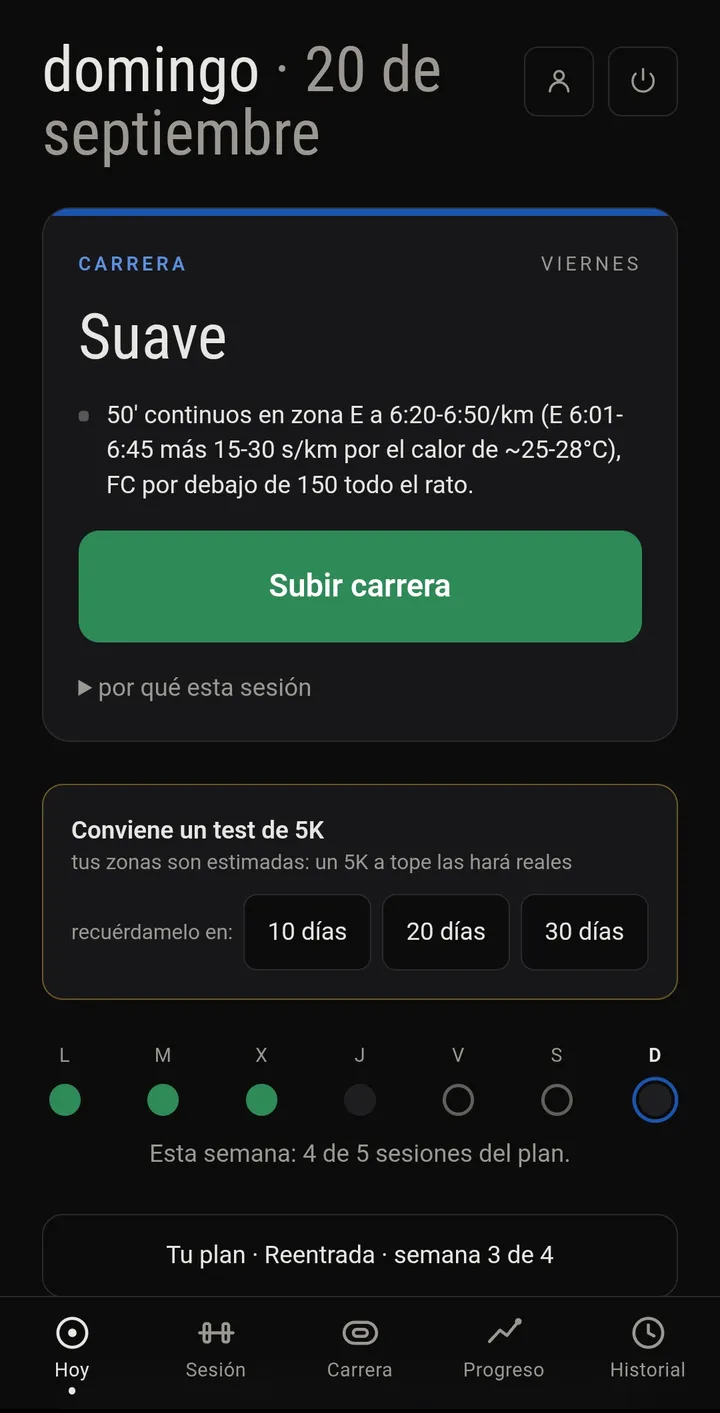
Today: what is on, and why - 2
How does it decide my sets and my weights?
Every muscle group has a weekly range of effective sets: a minimum to progress and a maximum not worth passing. The four-week block raises the volume little by little and the fourth week deloads.
In every exercise, double progression: reps rise within their range first; when you reach the top with margin, the weight goes up and you start again. It never asks you to fail: you work leaving one, two or three reps in the tank.
Your best lift is not tested: it is estimated with Epley's formula corrected by your effort, set by set. And the first week starts light, with no preloaded weights, until there is a history.
Volume landmarks (MEV, MAV, MRV), double progression, RIR.
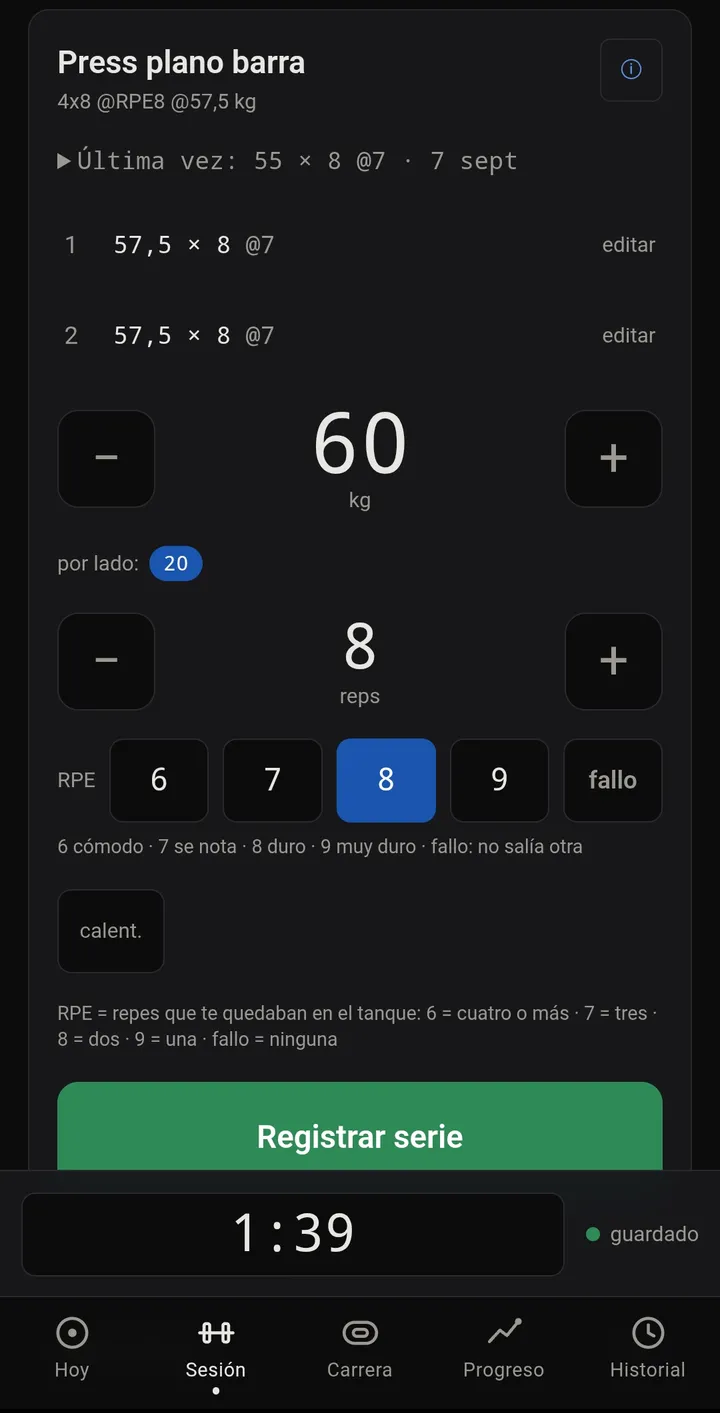
A set, in two taps - 3
How does it fit everything I do together without breaking me?
With fixed rules when it writes the week: hard sessions kept apart, never three gym days in a row, easy days truly easy, and on a day with lifting and an easy run, the lifting first.
Everything you do goes into one load account, with your effort and the minutes: the gym, the run, the group class, the padel, and the sports still to come. One person, one account.
On that account it watches the ratio between the last week's load and the average of the four before. If it leaves the healthy band, the coach eases or holds; if it persists, it rethinks the block instead of insisting.
Strength-endurance interference, effort-based load (sRPE), acute and chronic load.
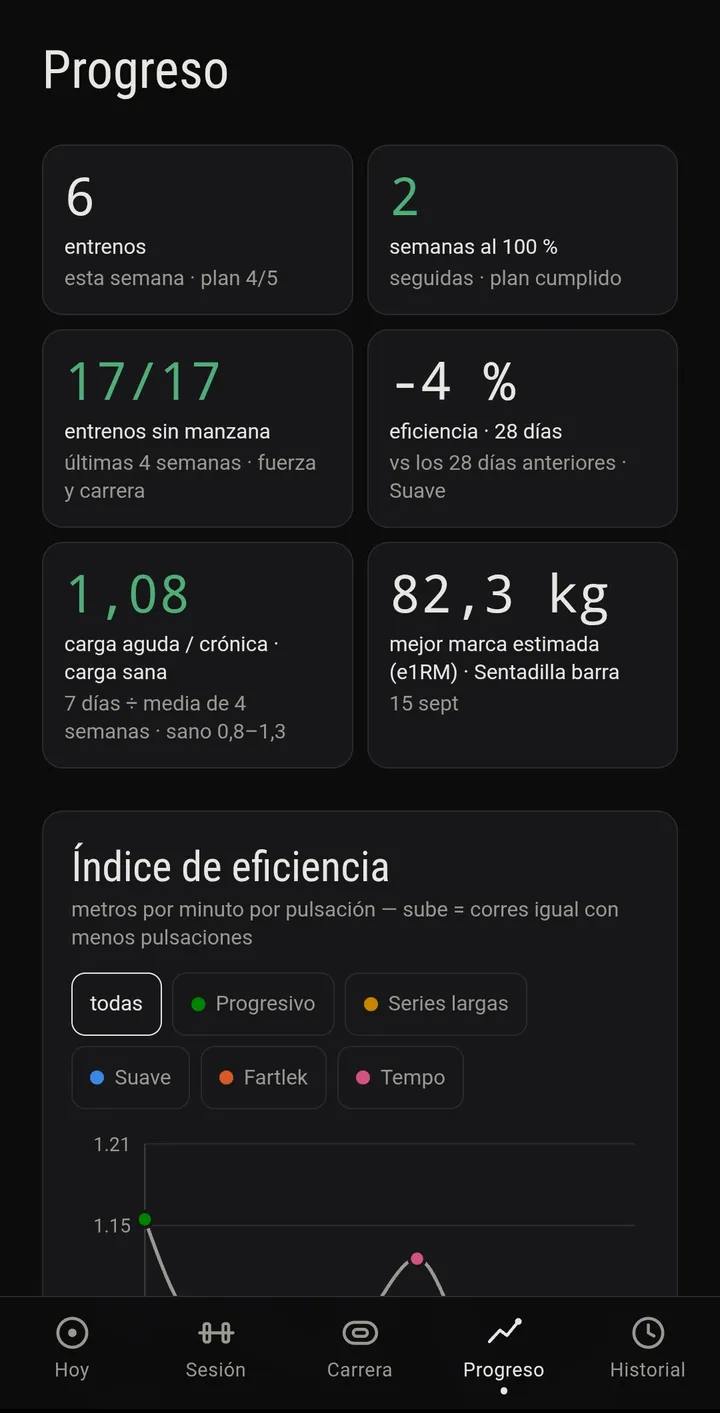
The numbers, computed - 4
What happens when the week goes sideways?
When you close a workout the coach reads it and, when it helps, offers to rewrite what is left of the week. You decide, with one line of context if you want: “the gym was packed, forget the cable machine”.
The rewrite has limits: it only touches what is pending, adds or removes no sessions, never cuts more than 30 % and happens at most twice a week. If more is needed, it rethinks the block instead of patching.
Going on holiday or travelling, falling ill or getting injured: you tell it beforehand with a note on what you will be able to do. The plan fits itself to that; if you are ill, it rests. And on your return it does not pick up where you left off: it starts one step below and climbs back over four weeks.
Bounded adjustments, declared periods, progressive return.
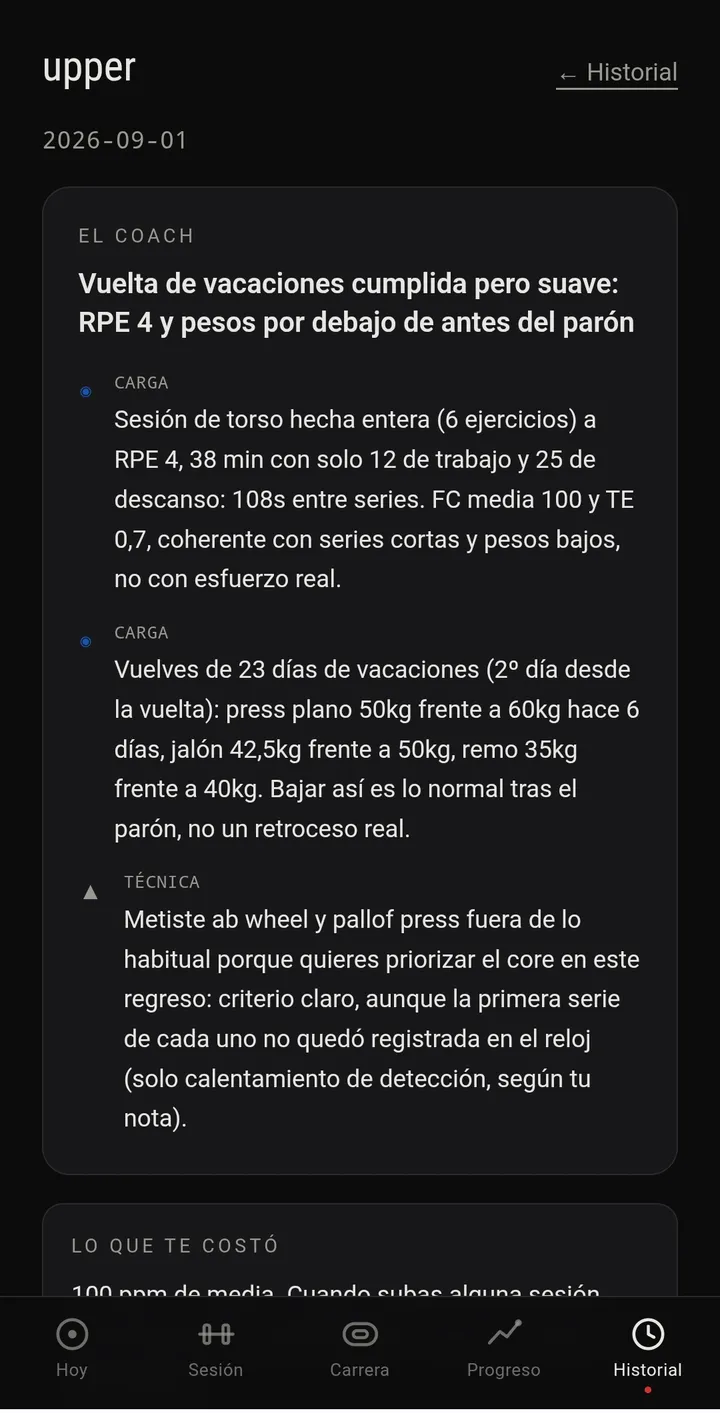
The coach reads every workout - 5
And everything else I do?
It counts. A group class, a padel match, a hike: you log it in a minute with the duration and your effort, or it arrives from your watch.
The coach does not programme the class, but it takes it into account: that load goes into the same account as the gym and the running, and next week is written knowing it.
Today it prescribes strength and running. Cycling and swimming come next, and the method is built so every new sport enters the same account, not another app.
One load account by effort and minutes.
- 6
What does it not do?
It does not diagnose or treat injuries. If something hurts, a health professional; the coach works around what you tell it.
It is not a chat: it reads your history and writes plans and readings without being asked. And the plan is not edited by hand: the AI proposes, you decide. If you prefer to be in charge, companion mode logs and only proposes when you ask.
It does not measure your sleep or your heart-rate variability. What it knows about your rest is what you tell it when you close each workout.